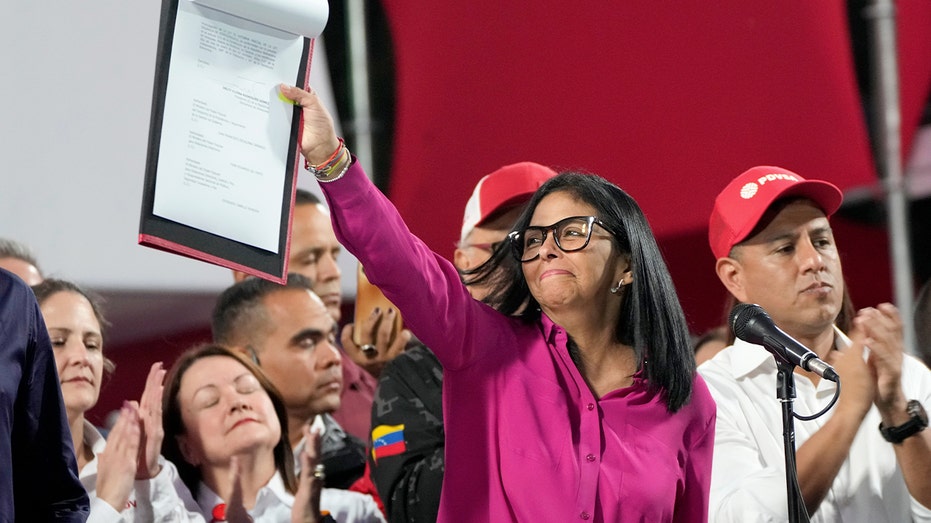
Venezuela’s acting President Delcy Rodriguez signed a law overhauling the nation’s oil sector, opening it to privatization. The move reverses a core policy of the socialist movement that has ruled the country for more than two decades.
Rodriguez’s policy shift, aimed at luring the foreign investors needed to rework the industry, comes less than one month after the U.S. captured former Venezuelan dictatorial leader Nicolás Maduro. The acting president, who served as Maduro’s vice president prior to his capture, was facing pressure from the Trump administration, which was eyeing Venezuela’s oil industry after imposing sanctions.
On Jan. 10, Trump hosted nearly two dozen top oil and gas executives at the White House. He said American energy companies will invest $100 billion to rebuild Venezuela’s “rotting” oil infrastructure and push production to record levels.
TRUMP ADMINISTRATION EASES SANCTIONS ON VENEZUELAN OIL INDUSTRY AFTER MADURO’S CAPTURE
That same day, Trump signed an executive order titled “Safeguarding Venezuelan Oil Revenue for the Good of the American and Venezuelan People,” blocking U.S. courts from seizing Venezuelan oil revenues held in American Treasury accounts.
“We’re talking about the future. We are talking about the country that we are going to give to our children,” Rodríguez said of the reform, according to The Associated Press.
AMERICAN ENERGY DOMINANCE GIVES US THE POWER TO FEND OFF ENEMIES AND RESCUE VENEZUELA
The legislation ends the state-owned Petróleos de Venezuela SA’s (PDVSA) monopoly over the production and sale of oil, as well as pricing, and allows private companies to take control, the AP reported.
The new law states that a private company “will assume full management of the activities at its own expense, account, and risk, after demonstrating its financial and technical capacity through a business plan approved by” Venezuela’s Oil Ministry, according to the AP. However, the outlet added that the law leaves control of hydrocarbon reserves operated by private companies with the government.
The law also allows for independent arbitration of disputes, ending the requirement that they be settled in Venezuelan courts controlled by the ruling party, according to the AP. Additionally, it modifies extraction taxes, setting a royalty cap rate of 30%, the AP reported.
President Donald Trump and Secretary of State Marco Rubio spoke with Rodriguez on Thursday, the AP reported. The call came just one day after the secretary explained to senators how the administration was planning to handle the sale of tens of millions of barrels of oil from Venezuela, the AP added. The outlet noted that Venezuela has the largest reserves of crude oil in the world.
“What we hope to do is transition to a mechanism that allows that to be sold in a normal way, a normal oil industry, not one dominated by cronies, not one dominated by graft and corruption,” Rubio said at a Senate hearing on Wednesday.
The secretary said that the U.S. would retain control of the oil revenue and that Venezuela would submit monthly budget outlining what they need funded. Subsequently, the funds will be moved into an account over which the U.S. will have oversight. He explained that the money would not be in the hands of the U.S., but Washington would control its disbursement to ensure it benefits the Venezuelan people.
The Associated Press contributed to this report.